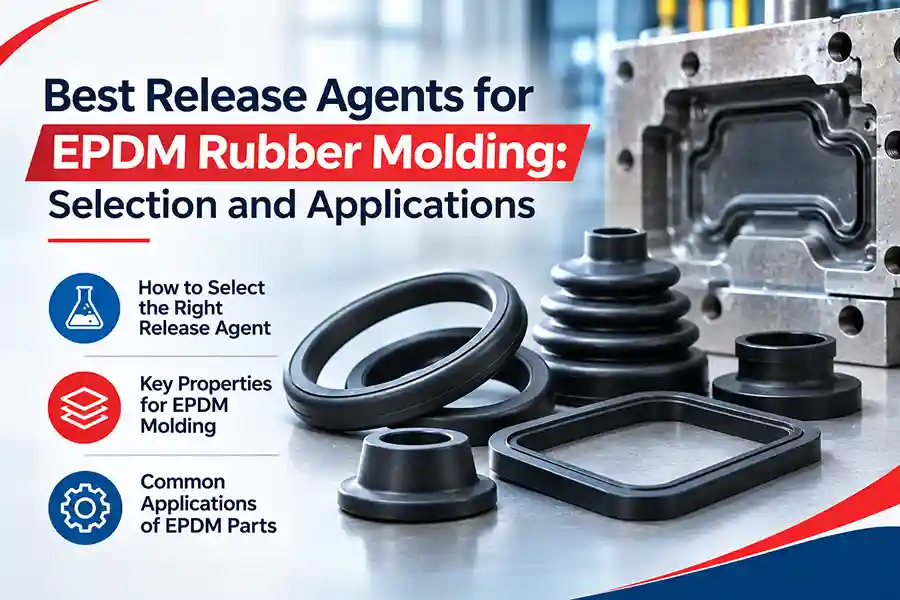
Pick the wrong EPDM rubber release agent and you’ll know fast. Parts tear on demolding. Cavities foul up. Bonded parts fail weeks later in the field. This guide covers what actually works for EPDM, and it sits inside our wider range of Rubber release agent solutions if you want the full picture.
Why EPDM is fussy
EPDM cures hot, usually somewhere between 150°C and 200°C, with sulfur or peroxide systems. At those temperatures the rubber grips bare steel hard. Residue also bakes onto the mold quicker than you’d expect, and once it builds up, surface finish and dimensions start to drift.
Then there’s what happens after molding. A lot of EPDM parts get bonded, painted, flocked or printed. That one detail should drive most of your choice.
The main options
Semi-permanent coatings. These bond to the mold surface and give you many releases per application. You spray less, clean less, and lose less cycle time. For high-volume runs, honestly, this is where I’d start.
Water-based agents. Easy to apply, low odor, no solvent fumes. They need a properly hot mold to flash off cleanly, so they suit general-purpose molding well.
Silicone-based agents. Cheap and strong. But silicone transfers to the part, and that wrecks adhesion. If anything gets glued, coated or printed later, skip them.
Solvent-based and dry-film types. Thin films that behave in tight, detailed cavities. Good when a heavier coat would blur your geometry.
How to choose
Run through these before you order:
- Does the part get bonded, painted or printed afterward?
- What’s the mold temperature and cycle time?
- How complex is the cavity?
- How many shots are you running per shift?
- Does the part touch drinking water or food? EPDM is common in both, so check certifications.
The first question usually knocks out half your options.
Where each one shows up
Automotive weatherstrips and door seals often need a silicone-free approach because of flocking and coatings. Gaskets and HVAC seals tend to do fine with water-based agents. Hoses and long-run molded parts benefit most from semi-permanent coatings. Electrical insulators and complex molded profiles often call for thin dry films.
A few habits that help
Apply less than you think you need. Heavy coats cause buildup and surface defects, not better release. Clean the mold fully before switching agent types, because mixed chemistries cause strange problems. And test on a single cavity first. Ten minutes of testing beats a scrapped batch.
Wrapping up
There’s no single best EPDM rubber release agent. The right one depends on your cure temperature, your part geometry, and what happens to the part afterward. Get those three straight and the choice gets easy.
Want to compare formulations across rubber types? Head to our Rubber release agent page, or talk to the Durafine team about your mold setup.