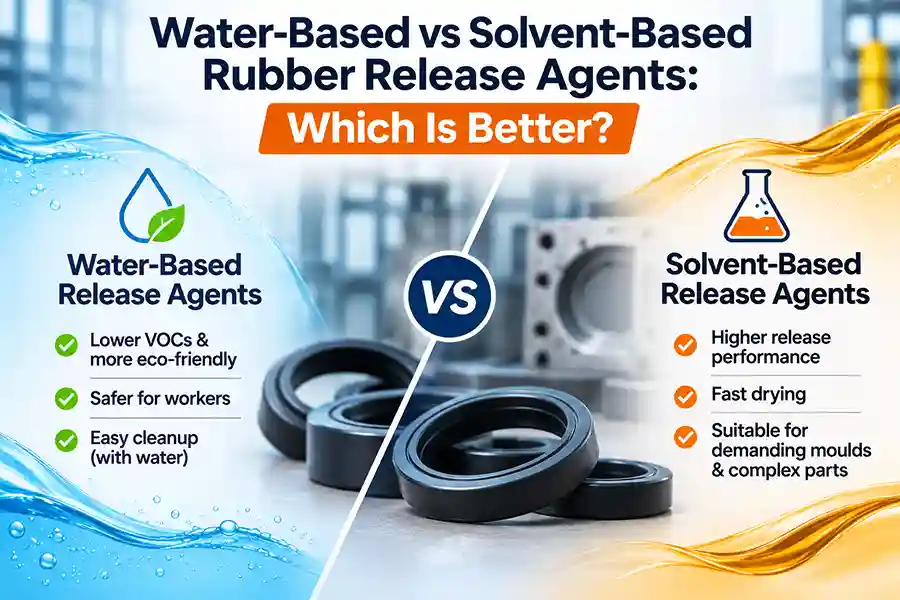
Ask ten rubber molders about rubber release agents and you’ll get a split answer on one point in particular. The water based vs solvent based release agent question never fully settles, because the right pick depends on your mold temperature, your part geometry and how well your shop is ventilated. Still, one type wins more often than the other, and it’s worth knowing why.
What actually separates them
Both do the same job. They leave a thin film between the cured rubber and the mold so parts come out clean. The only real difference is the carrier. A water-based agent suspends silicone, wax or polymer in water. A solvent-based one dissolves the same kind of actives in a hydrocarbon solvent.
That one change affects drying time, safety, coverage and cost.
Where water-based wins
Rubber molds run hot, often well above 150°C. On a surface like that, water flashes off almost instantly and leaves the release film behind. No waiting, no pooling.
Safety is the other big one. There’s no flammable vapour and VOC levels are low, so operators breathe easier and compliance paperwork gets simpler. Most are also sold as concentrates you dilute with water, so a drum goes further than the price suggests.
For compression, transfer and injection molding on heated tooling, water-based is what I’d try first. Honestly, it’s usually the right call.
Where solvent-based still earns its place
Cold or only mildly warm molds are the problem for water. It dries slowly there, and trapped moisture can mark the part or leave droplets in the cavity. Solvent flashes off fast at almost any temperature.
Detailed cavities are the second case. Solvent spreads thin and even into deep undercuts and tight corners, where water can bead up. And if your tooling is plain steel that rusts easily, a water film left sitting on it is a risk you have to manage.
The price is flammability, stronger fumes and the need for proper ventilation and storage. That cost is real, and some plants have stopped accepting it.
How to choose
Start with mold temperature. Hot tooling points to water-based. Cold tooling or intricate detail points to solvent-based.
Then check your plant. If ventilation is limited or you’re under VOC restrictions, the decision is mostly made for you.
Last, run a trial. Spray a few cycles of each on the same mold with the same compound and watch for part release, surface finish and buildup on the tool. A week of real production data beats any datasheet. If you want to see the full range before you test, our guide to rubber release agents covers the options by process.
Neither one is better in every case. But if you’re still unsure, tell me what rubber you’re molding and at what temperature. That usually settles it.